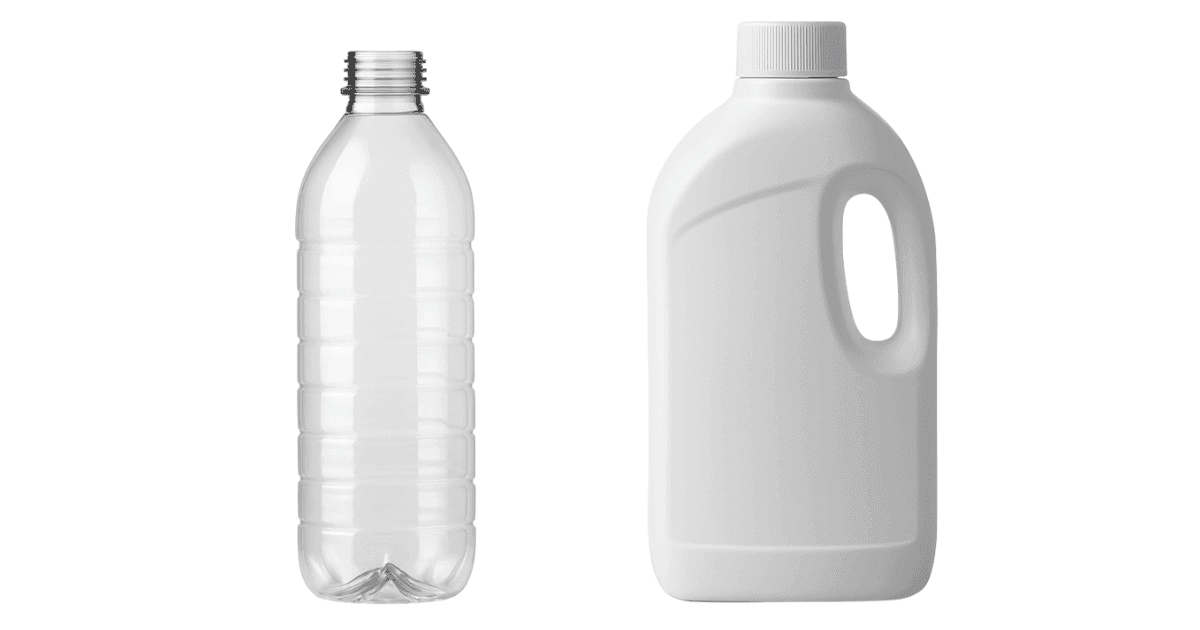
PET vs HDPE Bottles: Which One Is Better for Chemical Packaging?
Selecting the right plastic bottle for chemical packaging is not a purely material-driven decision. It directly affects product safety, shelf life, transport reliability, regulatory compliance, and long-term operational cost. While both PET and HDPE bottles are widely used in industrial packaging, they serve different purposes and perform differently depending on the chemical formulation and usage conditions.
This article compares PET and HDPE bottles specifically from a chemical packaging perspective, helping manufacturers, distributors, and procurement teams make informed, application-driven decisions.
Understanding PET and HDPE as Packaging Materials
Polyethylene Terephthalate (PET) and High-Density Polyethylene (HDPE) are two of the most commonly used plastics in industrial packaging, but their material properties differ significantly.
PET is a rigid, transparent thermoplastic known for its clarity, stiffness, and lightweight nature. It is widely used where product visibility and aesthetic presentation are important.
HDPE, on the other hand, is an opaque or semi-opaque thermoplastic with a dense molecular structure. It offers superior chemical resistance, impact strength, and stress-crack resistance, making it more suitable for demanding industrial environments.
Understanding these fundamental differences is key to choosing the correct bottle for chemical products.
Chemical Resistance and Material Compatibility
When it comes to chemical packaging, material compatibility is the most critical factor.
HDPE bottles offer excellent resistance to a wide range of chemicals, including acids, alkalis, alcohols, and many solvents. This makes HDPE the preferred choice for industrial chemicals, agrochemicals, automotive fluids, detergents, and cleaning agents. HDPE is less likely to degrade, soften, or interact with aggressive formulations over time.
PET bottles provide good resistance to water-based solutions and some mild chemicals, but they are more sensitive to high-pH substances, strong acids, and certain solvents. Prolonged exposure to incompatible chemicals may lead to stress cracking or material weakening.
For applications involving unknown or aggressive formulations, HDPE generally offers a wider safety margin.
Mechanical Strength and Handling Performance
Chemical packaging is rarely handled gently. Bottles are stacked, palletized, transported, and sometimes exposed to harsh logistics conditions.
HDPE bottles are known for their excellent impact resistance. They perform well under drops, vibration, and compression, which reduces the risk of leakage or breakage during transport and storage. This robustness makes HDPE particularly suitable for export shipments and industrial distribution networks.
PET bottles are stiffer and more rigid, which can be an advantage for shape retention and shelf appearance. However, they are more brittle compared to HDPE and may crack under impact or stress, especially at lower temperatures.
For chemical products that require rugged packaging, HDPE generally offers more reliable handling performance.
Barrier Properties and Product Stability
Barrier performance plays an important role in maintaining chemical stability.
PET has superior gas barrier properties compared to HDPE, particularly against oxygen and carbon dioxide. This makes PET suitable for products where gas permeability is a concern, such as certain formulations that are sensitive to oxidation.
HDPE has lower gas barrier performance but compensates with stronger resistance to moisture and chemical interaction. For most industrial chemicals, barrier performance is less critical than material compatibility and structural integrity.
The choice depends on whether the chemical formulation is more sensitive to gas exchange or to material interaction.
Transparency, Appearance, and Product Visibility
PET bottles are naturally transparent, offering excellent product visibility. This is beneficial when visual inspection, color presentation, or consumer-facing appearance is important.
HDPE bottles are typically opaque or semi-transparent. While this limits product visibility, it provides better protection against light exposure, which can be beneficial for light-sensitive chemicals.
In purely industrial and B2B environments, visibility is often secondary to performance. However, for products where visual level indication is needed, both materials can be designed accordingly.
Closure Compatibility and Sealing Options
Chemical packaging often requires specialized closures to ensure safety and compliance.
HDPE bottles are widely compatible with tamper-evident caps, induction seals, vented closures, and chemical-resistant liners. This makes them highly adaptable to safety-focused packaging systems.
PET bottles can also be used with induction seals and tamper-evident caps, but closure compatibility must be evaluated carefully for chemical applications, particularly when using aggressive substances.
For hazardous or volatile chemicals, HDPE bottles combined with appropriate liners and closures are generally the safer option.
Temperature Resistance and Storage Conditions
Temperature fluctuations during storage and transport can affect packaging performance.
HDPE maintains its mechanical properties across a wider temperature range, including lower temperatures. It is less likely to become brittle in cold conditions.
PET performs well at moderate temperatures but may become more brittle in cold environments and deform under higher heat conditions.
For chemicals stored or transported across varying climates, HDPE provides more consistent performance.
Sustainability and Recycling Considerations
Both PET and HDPE are recyclable and widely accepted in global recycling systems.
PET is often favored in recycling streams due to its high recycling rates and established infrastructure, particularly in consumer packaging.
HDPE is also fully recyclable and commonly used in industrial recycling programs. Its durability and reusability in certain applications contribute positively to sustainability goals.
From an environmental standpoint, the most sustainable option is the one that minimizes leakage, waste, and product loss—factors where HDPE often has an advantage in chemical packaging.
Cost and Supply Chain Efficiency
Cost considerations extend beyond material price.
HDPE bottles are generally more forgiving in production and handling, which can reduce losses caused by damage or incompatibility. Their durability can result in lower total cost of ownership over time.
PET bottles may offer cost advantages for lightweight, high-volume applications where chemical compatibility is not a limiting factor.
For chemical packaging, the cost of failure often outweighs marginal material savings, making HDPE a safer long-term investment in many cases.
Which One Is Better for Chemical Packaging?
There is no universal answer, but in most chemical packaging applications, HDPE bottles are the preferred choice due to their superior chemical resistance, mechanical strength, and safety margin.
PET bottles may be suitable for mild, water-based, or non-reactive chemicals where transparency and gas barrier properties are required.
The final decision should always be based on:
Chemical formulation and concentration
Storage and transport conditions
Required closure and sealing systems
Regulatory and safety requirements
Conclusion
PET and HDPE bottles each have their place in industrial packaging, but their suitability for chemical applications differs significantly. HDPE bottles offer broader chemical compatibility, stronger impact resistance, and more reliable performance under demanding conditions, making them the go-to solution for most chemical packaging needs.
PET bottles can be an effective option for specific, less aggressive formulations where clarity and barrier properties are prioritized. For manufacturers and distributors, understanding these differences is essential to selecting packaging that ensures safety, compliance, and long-term operational stability.
Need Packaging Solutions?
Explore our wide range of high-quality plastic bottles, jars, and caps perfect for your products.