UN Certification for Hazardous Chemical Packaging: What Buyers Need to Know
When a chemical is classified as a dangerous good, the container it travels in is not a purchasing decision — it is a regulatory requirement. The wrong container, however well-made, is not a compliant container. And a non-compliant container carrying a hazardous chemical is a liability at every point in the supply chain: at the loading dock, at the border, and in the event of an incident.
UN certification is the international standard that defines what "compliant" means for dangerous goods packaging. Understanding what the certification covers, how to read the markings, and what to ask your supplier is the starting point for getting the specification right.
What UN certification actually means
The UN certification framework for packaging is established by the UN Recommendations on the Transport of Dangerous Goods — commonly known as the Orange Book. This framework is adopted, with minor variations, into the major transport regulations that govern road (ADR), sea (IMDG), rail (RID), and air (IATA) transport of dangerous goods.
A UN-certified container has been tested to a defined set of performance standards by an accredited testing body. The tests vary by container type but typically include:
Drop test — the container is dropped from a specified height onto a hard surface in multiple orientations to verify it does not leak or rupture
Stacking test — the container is subjected to a compressive load equivalent to a defined stack height for a defined period to verify it does not deform or fail
Hydraulic pressure test — the container is pressurised internally to verify the body and closure maintain integrity under pressure
Leakproofness test — the container is tested to verify the closure system does not allow liquid to escape under defined conditions
Only containers that pass these tests, manufactured to the same specification, may carry the UN marking. The certification applies to the container as a system — body and closure together — not to the body alone.
Reading the UN marking
Every UN-certified container carries a marking that encodes its certification parameters. Understanding this marking allows buyers to verify that a container is certified for their specific application before purchasing.
A typical UN marking looks like this:
UN 3H1/Y1.5/100/25/TR/XXXX
Each element has a specific meaning:
UN — confirms the container meets UN performance standards
3H1 — container type code. The number indicates the container category (3 = jerrican, 4 = box, 6 = composite IBC, etc.), the letter indicates the material (H = HDPE, A = steel, G = fibre), and the digit indicates the specific design within the category
Y — packing group compatibility. X = suitable for Packing Groups I, II, and III; Y = suitable for Packing Groups II and III; Z = suitable for Packing Group III only
1.5 — maximum gross mass in kg (for solids) or specific gravity (for liquids) for which the container is certified
100 — hydraulic test pressure in kPa (for liquids)
25 — year of manufacture (2025)
TR — country of manufacture code
XXXX — manufacturer identification code assigned by the competent authority
For a buyer, the critical elements are the container type code (confirming the material and design), the packing group letter (confirming the hazard classification your chemical falls under), and the specific gravity or mass rating (confirming the container is certified for the density of your product).
Packing groups: matching the container to the hazard
Dangerous goods are assigned to one of three packing groups based on their degree of hazard:
Packing Group I (X) — high hazard. Substances presenting a serious danger. Examples: certain flammable liquids with very low flash points, highly toxic substances.
Packing Group II (Y) — medium hazard. Substances presenting a medium danger. Examples: many common industrial chemicals, moderately toxic substances, flammable liquids with flash points in the mid range.
Packing Group III (Z) — low hazard. Substances presenting minor danger. Examples: many dilute solutions, mildly flammable liquids, low-toxicity substances.
The packing group of your chemical is determined by its classification under the relevant dangerous goods regulations — not by the buyer, but by the chemical manufacturer or importer, documented in the safety data sheet (SDS) and the dangerous goods declaration.
The container's UN marking must include a packing group designation that covers your chemical's packing group. A container marked Y is certified for Packing Groups II and III — it cannot be used for a Packing Group I substance regardless of its physical performance.
IBC containers and UN certification
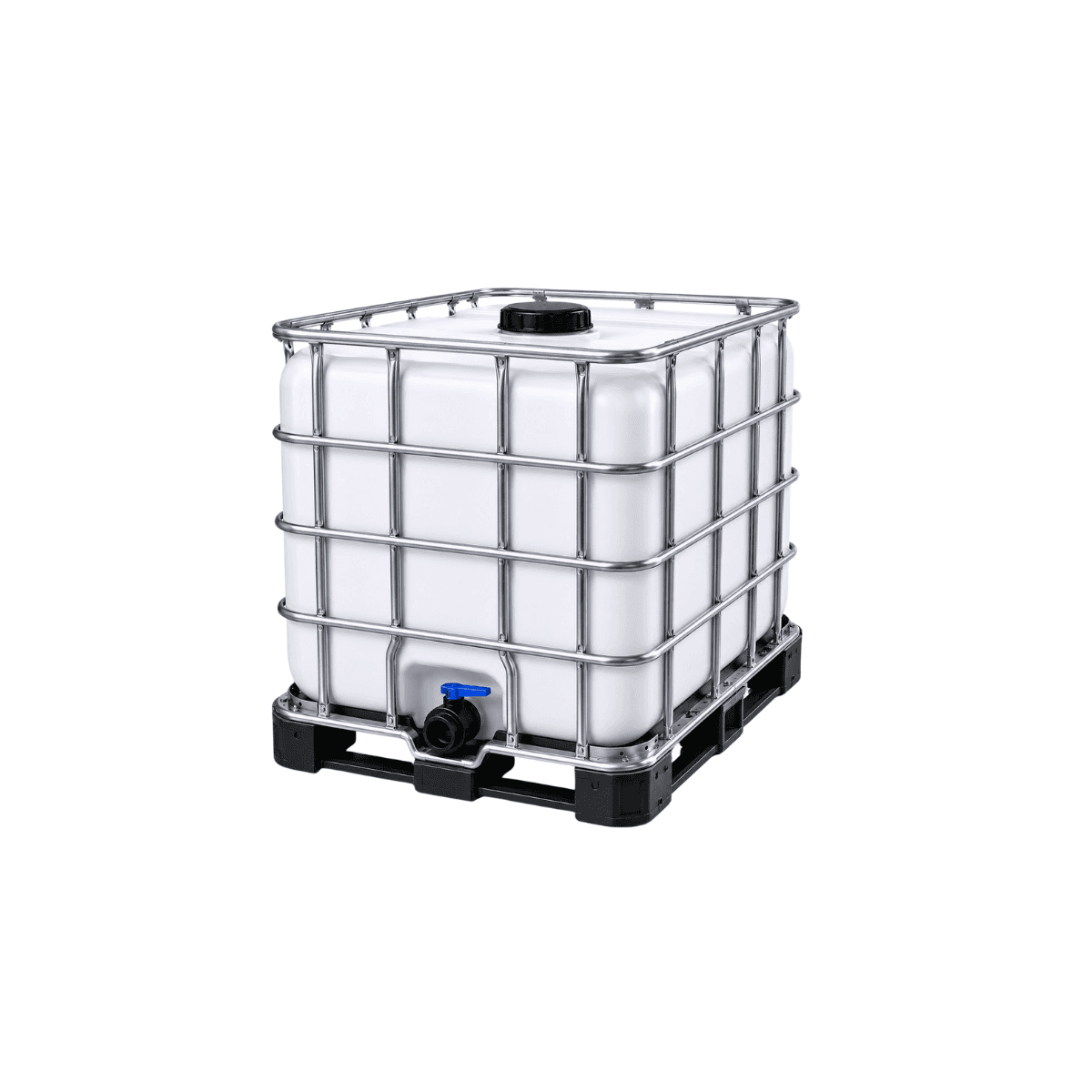
Intermediate Bulk Containers (IBCs) are the standard format for bulk hazardous chemical transport and storage at volumes between approximately 400 and 3,000 litres. The most common format for liquid chemicals is the composite IBC — an HDPE inner container within a steel or aluminium outer cage, on a pallet base.
UN certification for IBCs follows the same framework as for smaller containers but with IBC-specific test protocols. The UN type code for composite IBCs with HDPE inner containers begins with 31H — for example, 31HA1 denotes a composite IBC with an HDPE inner container and a steel outer frame.
At Alternaplast, we supply UN-certified 1,000-litre composite IBCs with metal pallet bases — the standard format for bulk liquid chemical transport. These containers carry the full UN marking confirming certification parameters, packing group compatibility, and year of manufacture.
Key specifications for buyers:
Volume: 1,000 litres nominal capacity
Inner container: HDPE — compatible with the range of industrial chemicals outlined in the chemical resistance profile for HDPE
Outer frame: Steel cage with metal pallet base
UN certification: Confirmed at order stage — packing group and specific gravity compatibility verified against your chemical and application
Closure: DN150 or DN50 top openings depending on configuration; closure specification coordinated with fill and discharge requirements
For buyers specifying UN-certified IBC packaging for the first time, or transitioning from non-certified to certified containers, our team can confirm certification parameters and provide documentation for dangerous goods compliance purposes.
Drums and barrels for UN-certified chemical transport
For volumes between approximately 30 and 220 litres, HDPE drums and steel drums are the standard UN-certified formats for liquid hazardous chemicals.
HDPE drums — UN type code 1H1 (closed head) or 1H2 (open head) — are suitable for a wide range of liquid chemicals compatible with HDPE. They offer the chemical resistance advantages of HDPE in a robust format certified for dangerous goods transport.
Steel drums — UN type code 1A1 (closed head) or 1A2 (open head) — are required for chemicals incompatible with HDPE, including aromatic and chlorinated solvents, and for certain high-hazard Packing Group I substances where steel provides the required structural and containment performance.
The choice between HDPE and steel drums is primarily a chemical compatibility decision — the same material selection logic that applies to smaller containers applies here. For chemicals compatible with HDPE, HDPE drums are typically preferred for their weight advantage (significantly lighter than steel at equivalent volume), corrosion resistance, and compatibility with a wider range of contents without residue concerns.
For specific drum availability and UN certification parameters, contact our team directly.
What to ask your supplier
When purchasing UN-certified containers for hazardous chemical packaging, the following questions ensure the container is genuinely appropriate for your application:
1. What is the UN type code, packing group, and specific gravity rating on the marking? Confirm these match your chemical's classification and density before committing to a container specification.
2. Is the certification current? UN certifications are issued for specific manufacturing batches. Confirm that the containers being supplied are manufactured to the certified specification, not a modified version.
3. What documentation is available? For audit and compliance purposes, your supplier should be able to provide the test certificate or certification documentation from the accredited testing body.
4. Does the certification cover the closure as well as the body? UN certification applies to the container as a system. Confirm that the closure being supplied is part of the certified system — a different closure on a certified body does not constitute a certified container.
5. What is the reuse policy? UN-certified containers for certain dangerous goods have defined reuse limitations. For IBCs in particular, recertification or inspection requirements may apply after a defined number of uses or a defined period.
A note on non-certified containers for non-regulated chemicals
Not all industrial chemicals are classified as dangerous goods under transport regulations. Many common process chemicals, cleaning agents, and industrial liquids do not meet the classification criteria for dangerous goods and can be transported in non-certified containers without regulatory restriction.
If your chemical is not classified as a dangerous good, UN certification is not a requirement — though higher-specification containers may still be appropriate for safety and product integrity reasons. If you are uncertain about the classification of your chemical, the starting point is the SDS section 14 (Transport Information), which documents the dangerous goods classification if applicable.
Enquire about UN-certified IBC availability and certification documentation →
Need Packaging Solutions?
Explore our wide range of high-quality plastic bottles, jars, and caps perfect for your products.