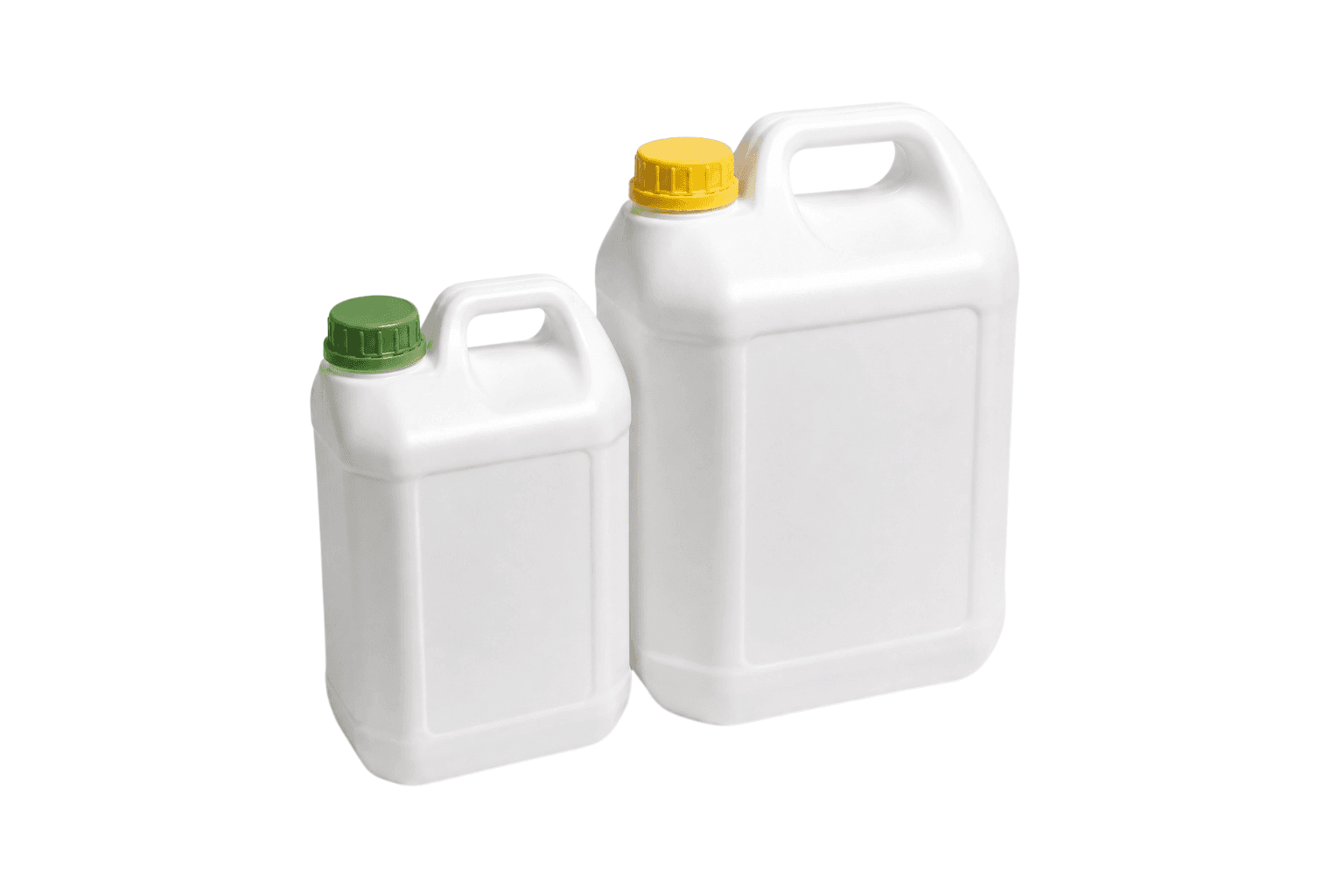
Vented HDPE Jerry Cans for Agrochemicals: Design, Selection, and Compliance
A 5-litre jerry can sitting in a distribution warehouse in July is a different engineering problem from a 100 ml bottle on the same shelf. The volume is larger, the headspace is greater, the structural loads are different, and the consequences of a pressure-related failure — a leaking seal, a deformed body, a cap that takes real effort to open — are proportionally more significant.
For agrochemical formulators and packaging buyers specifying larger containers, the vented closure question that applies to small bottles applies here too — but the design considerations shift when you move from bottles to jerry cans. This article covers what those differences are, how to select the right vented jerry can for agrochemical use, and what compliance requirements apply at this container scale.
Why jerry cans behave differently under pressure
The physics of pressure buildup — vapour pressure, off-gassing, temperature sensitivity — are the same regardless of container size. (If you want the full explanation, Why Do Pesticide Containers Build Up Pressure — and How Vented Closures Solve It covers the mechanisms in detail.)
What changes at larger volumes is the scale of the effect.
Headspace volume is larger. A 5-litre jerry can filled to 90% capacity has approximately 500 ml of headspace — ten to twenty times the headspace of a typical 250 ml bottle at the same fill ratio. More headspace means more room for vapour to accumulate before equilibrium is reached, which means higher absolute pressure differentials across the container walls and closure.
Wall surface area is greater. A larger container has more wall area exposed to internal pressure. HDPE is flexible by design — it is this flexibility that allows containers to absorb moderate pressure without cracking — but sustained pressure across a large surface area causes measurable deformation. A 10-litre or 20-litre jerry can that has bulged outward by even a few millimetres will not stack or palletise correctly, creating downstream logistics problems.
The closure-to-volume ratio decreases. The cap on a 5-litre jerry can is sealing a much larger pressurised volume than the cap on a 250 ml bottle. The seal integrity requirement is therefore higher, and the consequence of seal degradation — product migration, vapour escape, contamination risk — is proportionally larger.
These factors combine to make pressure management at jerry can scale not just a product integrity issue, but a storage, transport, and handling issue.
Cap diameter and its role in vented performance
Jerry can closures come in a range of diameters. At Alternaplast, agrochemical jerry cans are available with 38 mm, 50 mm, 51 mm, and 63 mm closures depending on the container model and application.
Cap diameter matters for vented performance in two ways.
First, it determines the available membrane area. A vented closure houses a microporous PTFE membrane within the cap structure. A larger cap diameter accommodates a larger membrane, which allows a higher volumetric flow rate for pressure equalisation. For formulations with aggressive off-gassing behaviour, or for large-format containers where headspace volume is significant, a wider cap with a larger membrane area provides faster and more effective pressure relief.
Second, it determines pouring and dispensing behaviour. Agrochemical jerry cans are typically opened in the field by operators measuring and pouring concentrates. A 38 mm neck offers more controlled dispensing with less risk of splashing; a 63 mm neck facilitates faster emptying and easier cleaning between uses. The venting requirement should be specified independently of the dispensing requirement, and the closure selected to satisfy both.
For most agrochemical applications at 5-litre scale, a 50 mm vented closure provides a practical balance: sufficient membrane area for reliable pressure management and a neck opening suitable for controlled pouring.
Body geometry and agrochemical use
HDPE jerry cans are produced in several body geometries — rectangular, square, flat, F-style, and round — each with different implications for agrochemical use.
Rectangular and square bodies are the most common format for agrochemical concentrates. Their geometry maximises pallet density, which is relevant when distributing seasonal products in volume. Stackable variants with recessed bases and reinforced shoulders allow column stacking without closure-to-base contact, protecting the cap and seal during palletised storage.
Flat jerry cans have a reduced profile that suits certain storage and vehicle transport applications, particularly where container height is constrained. The J5008D (5 L, 50 mm) is an example of this format at agrochemical scale.
F-style jerry cans — named for their asymmetric handle and spout placement — are common in North American agrochemical markets and suit formulations that are dispensed frequently in small volumes. The handle-integrated design reduces wrist strain during repeated pouring.
The dedicated Agro Jerry Can (J5007D, 5 L, 50 mm) is specifically designed for agrochemical applications, with body geometry and closure sizing matched to field use requirements. This is the baseline recommendation for 5-litre pesticide and herbicide concentrates where a purpose-built container is preferred over a general-purpose format.
For larger volumes — 10 L, 20 L, and above — rectangular bodies with integrated handles are standard, as the weight of a full container at these volumes makes handle ergonomics a practical requirement rather than an optional feature.
Vented closures at jerry can scale: what to specify
When specifying a vented closure for an agrochemical jerry can, the following parameters define the requirement:
Cap diameter — as discussed above, determined by both container neck finish and performance requirements. Most agrochemical jerry cans in the 5–20 L range use 50 mm or 63 mm closures.
Membrane type — PTFE is the standard for agrochemical applications due to its broad chemical resistance. Most agrochemical solvents, including aromatic and aliphatic hydrocarbons, do not degrade PTFE under normal storage conditions.
Tamper-evidence integration — for product registration compliance and supply chain integrity, vented closures for agrochemicals should incorporate a tamper-evident feature. This is typically a breakable induction ring or a tear-tab that provides visible evidence of first opening. The vent membrane and tamper-evident ring are separate functional elements that operate independently.
Induction sealing compatibility — many agrochemical formulations require an aluminium foil induction seal at the point of filling for primary product protection. Vented closures can be specified with a foil liner that provides hermetic sealing before first use, after which the vent membrane manages ongoing pressure. This combination is strongly recommended for premium and export-oriented agrochemical products.
At Alternaplast, vented closures are available on request across the jerry can range — including the 5 L Agro Jerry Can (J5007D), standard 5 L and 10 L rectangular formats, and larger volumes. Closure specification is coordinated with the container selection to ensure the neck finish, cap diameter, and membrane specification are matched.
Wall thickness and container gramage: an underspecified variable
In agrochemical packaging, container gramage — the weight of the blown container before filling — is a proxy for wall thickness and structural integrity. A heavier container uses more HDPE material and produces thicker walls, which directly affects pressure resistance, stacking load capacity, and long-term durability in field conditions.
Gramage is rarely discussed at the specification stage but is frequently the source of field complaints when it is too low. A container that meets its dimensional specification but has thin walls will deform under sustained internal pressure and may fail under palletised stacking loads — particularly in warm-climate storage where both pressure and material creep are elevated.
At Alternaplast, jerry cans are produced across a range of gramage specifications to suit different applications and budget requirements:
5 L containers: 250–350 g
10 L containers: 400–550 g
20 L containers: 1,000–1,250 g
25 L containers: 1,100–1,250 g
For agrochemical applications involving volatile or pressure-generating formulations, higher-gramage containers within each range are recommended. The combination of a vented closure and a heavier-gauge container provides the most robust approach to pressure management: the vent handles pressure equalisation continuously, while the container walls maintain structural integrity under the residual loads of storage and transport.
Gramage specification is available on request and is coordinated with closure type, fill weight, and stacking requirements.
Compliance considerations for agrochemical jerry cans
Product registration and labelling requirements
Many jurisdictions require that pesticide and agrochemical products are packaged in containers that meet specific requirements as a condition of product registration. These requirements typically cover closure type, child-resistance, and tamper-evidence. In some markets, the packaging specification forms part of the registered label — meaning a change of container or closure after registration requires a regulatory amendment.
For export-oriented agrochemical products distributed across multiple markets, specifying a tamper-evident vented closure from the outset is significantly more straightforward than retrofitting compliance features to an existing packaging line.
Chemical compatibility
HDPE is broadly compatible with agrochemical formulations, including most solvent-based concentrates, emulsifiable concentrates, suspension concentrates, and water-based formulations. For highly concentrated aromatic solvents or specialist chemistries, compatibility testing against the specific formulation is recommended before full-scale adoption.
Selecting the right vented jerry can: a summary
Application | Recommended format | Cap diameter | Notes |
|---|---|---|---|
Pesticide / herbicide concentrate, 5 L | J5006D / J5007D Agro | 50 mm | Purpose-built agrochemical format |
Pesticide / herbicide concentrate, stackable 5 L | J5001D / J5005D | 38 mm / 50 mm | Maximises pallet density |
Crop protection concentrate, 10 L | J10003D | 50 mm | Standard rectangular format |
Liquid fertilizer concentrate, 10 L | J10004D | 63 mm | Wider neck for viscous formulations |
Large-volume concentrate, 20 L+ | Available on request | 60–63 mm | Vented closure specified at order |
All vented closures are available on request. Contact our team to confirm availability for specific container models.
Where to go from here
Browse our jerry can range to identify the base container that fits your volume and format requirements. For vented closure specification, request a quote directly — our team will confirm closure options, cap diameter compatibility, and lead times based on your formulation type and volume requirements.
Need Packaging Solutions?
Explore our wide range of high-quality plastic bottles, jars, and caps perfect for your products.