Why Do Pesticide Containers Build Up Pressure — and How Vented Closures Solve It?
A pesticide container that arrives swollen at a distribution centre is more than an inconvenience. It signals a mismatch between the formulation and the packaging — a mismatch that, left unaddressed, can progress from cosmetic deformation to seal failure, product leakage, and a serious handling hazard.
Pressure buildup in agrochemical containers is not random. It follows predictable chemistry and physics. Understanding the mechanisms behind it makes it possible to select packaging that manages the problem reliably — rather than discovering it after the fact in a customer complaint.
This article explains why pressure builds up inside pesticide containers, what factors accelerate it, and how vented closures interrupt the process.
The starting point: vapour pressure
Every liquid has a vapour pressure — a measure of how readily its molecules escape from the liquid surface and enter the surrounding air as gas. At any given temperature, a liquid and its vapour reach an equilibrium: molecules evaporate from the surface at the same rate they condense back into it.
In a sealed container, this equilibrium plays out in the headspace — the air gap between the liquid surface and the closure. As molecules evaporate from the formulation, the headspace fills with vapour. Once equilibrium is reached, the gas pressure in the headspace equals the vapour pressure of the formulation at that temperature.
For water at 20°C, this pressure is low and inconsequential. For many agrochemical formulations — particularly solvent-based concentrates — the picture is very different.
Why solvent-based formulations are high-risk
Emulsifiable concentrates (ECs), solvent-based suspension concentrates, and oil-based formulations commonly contain petroleum-derived or aromatic solvents as carriers. These solvents — xylene, naphtha, cyclohexanone, and similar compounds — have significantly higher vapour pressures than water. Some have vapour pressures ten to fifty times higher than water at the same temperature.
When these formulations are filled into a sealed container, the headspace equilibrates with the solvent vapour. The result is a measurable, sustained internal pressure — even at ambient temperature. The active ingredient itself may also contribute vapour pressure depending on its chemical class and concentration.
This is why two containers of the same size, one filled with a water-based suspension and one filled with an EC formulation, can behave so differently under identical storage conditions.
Temperature is the multiplier
Vapour pressure rises sharply with temperature — and this relationship is nonlinear. A modest temperature increase can produce a disproportionate increase in internal container pressure.
Consider a solvent-based formulation stored at 20°C that generates an internal pressure of 0.3 bar above ambient. At 40°C — a realistic temperature for a container left in direct sunlight during road transport, or stored in a non-climate-controlled warehouse in a warm climate — the same formulation may generate two to three times that pressure.
This is why container deformation reports often cluster in summer months and in warm-climate distribution regions. The formulation has not changed. The packaging has not changed. The temperature has — and that alone is enough to push internal pressure past what the container or its seal can passively manage.
This temperature sensitivity also explains why pressure-related packaging failures are often intermittent and difficult to reproduce in laboratory conditions. Testing at 20°C does not reveal problems that emerge at 35–40°C in the field.
A second mechanism: off-gassing from chemical activity
Not all pressure buildup comes from physical evaporation. Some agrochemical formulations undergo slow chemical reactions during storage that generate gas as a by-product.
The most common sources are:
Biological or fermentation-based products — microbial and biochemical pesticides can produce carbon dioxide as a metabolic by-product, particularly if temperature conditions activate biological activity.
Formulations with reactive components — certain combinations of surfactants, emulsifiers, or pH-sensitive actives can undergo slow hydrolysis or decomposition under storage conditions, releasing gas in the process.
Residual moisture reacting with active ingredients — in some formulations, trace moisture interacts with the active ingredient or a co-formulant to produce gas, particularly where the active is moisture-sensitive.
These mechanisms are distinct from vapour pressure — the gas is generated by chemistry, not evaporation — but the outcome is the same: increasing pressure in a sealed container over time.
What happens when pressure has nowhere to go
In a sealed container, accumulating pressure distributes itself across the container walls and, critically, the closure interface. Most HDPE containers are designed to flex slightly under internal pressure — this is why bulging appears before cracking. The container is deforming to accommodate a pressure load it was not designed to sustain indefinitely.
The closure is typically the weakest point. Screw caps are sealed by the compression of a liner or membrane against the bottle neck. When internal pressure consistently exceeds the compressive force holding the seal, product migrates past it. This may initially present as minor seepage around the cap, but it degrades the seal further with each pressure cycle — and pressure cycles with every temperature fluctuation.
Beyond product integrity, there is a handling risk. A container that has been under sustained pressure and is then opened by a user — a farmer, a field operator, a mixing technician — can release pressurised product suddenly. For concentrated pesticide formulations, this is not a trivial exposure event.
How a vented closure breaks the cycle
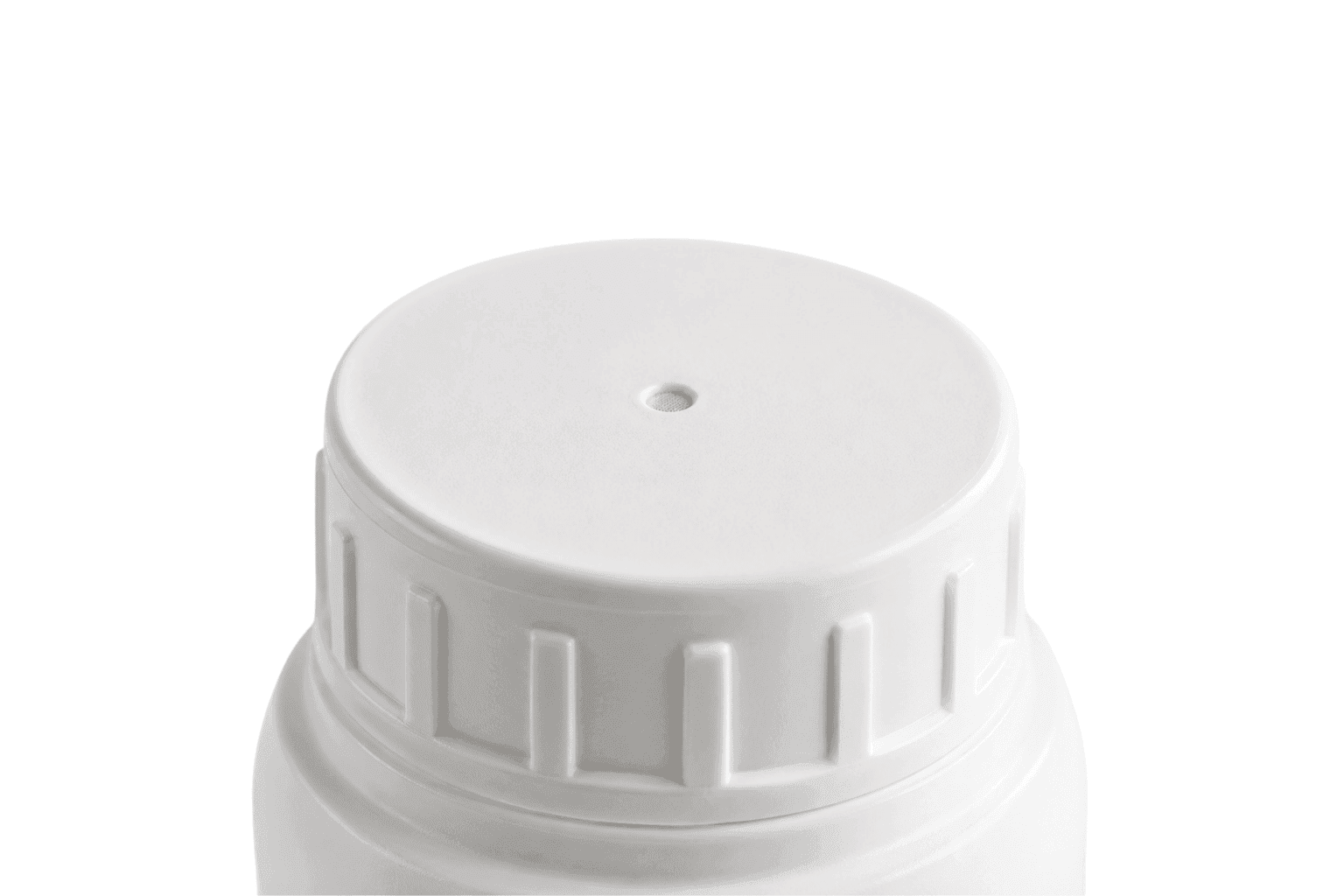
A vented closure introduces a controlled pressure relief pathway into the container system. The core component is a microporous membrane — most commonly made from PTFE (polytetrafluoroethylene) — bonded into the cap structure.
PTFE membranes are selected for two properties that work in combination:
Gas permeability — the pore structure of the membrane allows gas molecules to pass through in both directions. Vapour pressure that builds up in the headspace is continuously equalised with external atmospheric pressure. There is no pressure differential to accumulate.
Liquid impermeability — the surface energy of PTFE is very low, meaning liquid does not wet the membrane under normal conditions. The pores are small enough that the surface tension of the liquid prevents it from penetrating the membrane, even when the container is tilted or inverted during handling.
The result is a closure that breathes — maintaining pressure equilibrium continuously — while remaining impermeable to liquid product. The headspace pressure stays at or near atmospheric pressure regardless of temperature fluctuations or chemical off-gassing.
The membrane requires no maintenance and no activation. It functions passively for the service life of the container, which typically covers the full shelf life of the agrochemical product.
Aluminium foil lining and venting: how they work together
Many vented agrochemical closures also incorporate an aluminium foil induction seal. These two elements serve different functions and are compatible.
The foil seal is applied at the filling line and provides a hermetic barrier at the point of filling — protecting the product from moisture ingress, oxidation, and contamination during initial storage. When the user breaks the foil seal to open the container for the first time, the vent membrane takes over, managing pressure for the remainder of the container's in-use life.
This combination is common in premium agrochemical packaging precisely because it addresses two separate requirements: primary product protection and ongoing pressure management.
The practical implication for packaging specification
The practical implication for packaging specification is clear: the closure must be matched to the formulation's pressure behaviour, not selected by default. Vented closures are a manufacturer-level specification decision — the container leaves the filling line with the appropriate closure already in place. This is distinct from storage area ventilation, which is a separate and complementary requirement.
For solvent-based and EC formulations, vented closures should be the baseline assumption, not an optional upgrade. The same applies to liquid fertilizer concentrates — particularly those with high nitrogen content or biological additives, where gas generation during storage is a known risk. For warm-climate distribution, the specification should account for realistic peak temperatures rather than standard ambient conditions. For any formulation with a biological component or reactive chemistry, pressure behaviour during storage testing should be assessed directly.
The physical and chemical mechanisms behind pressure buildup are well understood. Packaging failures driven by pressure are, in most cases, preventable.
Where to go from here
If you are assessing whether your formulation requires a vented closure, Vented vs. Non-Vented Caps: When Does Your Agrochemical Container Need a Vent? covers the selection criteria in practical terms.
For vented HDPE bottles from 50 ml to 1 L — suitable for pesticides, herbicides, and liquid fertilizer concentrates — with tamper-evident and aluminium foil-lined options, see our vented container range. Vented closures for jerry cans and larger containers are available on request.
Need Packaging Solutions?
Explore our wide range of high-quality plastic bottles, jars, and caps perfect for your products.